A Brief History of Equality by Thomas Piketty
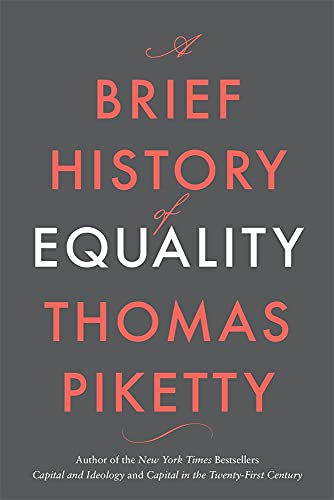
“An opportunity for readers to see Piketty bring his larger argument about the origins of inequality and his program for fighting it into high relief.” ―Nicholas Lemann, New York Times The world’s leading economist of inequality presents a short but sweeping and surprisingly optimistic history of human progress toward equality despite crises, disasters, and backsliding. A perfect introduction to the ideas developed in his monumental earlier books. It’s easy to be pessimistic about inequality. We know it has increased dramatically in many parts of the world over the past two generations. No one has done more to reveal the problem than Thomas Piketty. Now, in this surprising and powerful new work, Piketty reminds us that the grand sweep of history gives us reasons to be optimistic. Over the centuries, he shows, we have been moving toward greater equality. Piketty guides us with elegance and concision through the great movements that have made the modern world for better and worse: the growth of capitalism, revolutions, imperialism, slavery, wars, and the building of the welfare state. It’s a history of violence and social struggle, punctuated by regression and disaster. But through it all, Piketty shows, human societies have moved fitfully toward a more just distribution of income and assets, a reduction of racial and gender inequalities, and greater access to health care, education, and the rights of citizenship. Our rough march forward is political and ideological, an endless fight against injustice. To keep moving, Piketty argues, we need to learn and commit to what works, to institutional, legal, social, fiscal, and educational systems that can make equality a lasting reality. At the same time, we need to resist historical amnesia and the temptations of cultural separatism and intellectual compartmentalization. At stake is the quality of life for billions of people. We know we can do better, Piketty concludes. The past shows us how. The future is up to us. Read more
Is much of the world better off now than it was, say, 200 years ago? Yes, undoubtedly, says Thomas Piketty. He does not use the words “the arc of justice,” but I would. The transcendentalist theologian Theodore Parker was quite right when, around 1840, he perceived the arc of justice. The great moral emergency of Parker’s time was slavery. And the exploitations of colonialism were just getting started in Parker’s time. To see this progress in perspective, it’s necessary to be aware of just how terrible things have been for most people for most of history. That’s what the first half of Piketty’s book is about. The title of this book could as easily be “A Brief History of INequality.” If we failed to learn about historical inequality in school, it may not be entirely the fault of our educations. There is a great deal of new research on inequality. For example, Piketty several times refers to inheritance archives from 19th Century France. The bottom 50 percent of the population, even today, inherit nothing and own almost nothing. In fact they may be deeply in debt. At this stage of history, those who have benefited most from a reduction in inequality are the 40 percent between the bottom 50 percent and the top 10 percent — the middle class. The top 10 percent, and especially the top 1 percent, are obscenely rich, as always. The gains of the middle class are quite new, with most of that progress owed to the type of reforms that Franklin Roosevelt introduced in the U.S. after the Great Depression. There has been some backsliding since 1980, as the age of Reaganism, Thatcherism, and neoliberalism gained control. Piketty writes that neoliberalism is now discredited, especially after the financial crisis of 2008. But little progress has been made beyond neoliberalism because of political gridlock. It was, of course, the political struggles of organized progressives, going back for more than 200 years, that have made possible the gains in equality and social justice. It is sometimes hard for caring human beings to believe that there actually are people — lots of them — who hate the idea of equality, democracy, and justice, and who fight for a jackboot world that is unequal, undemocratic, unfair, and unjust. It’s easier now, post-Trump. We know who they are, we know what they want, and we’ve had a glimpse of just how they would use power to keep people down. The ironic thing is that many of the bottom-rung infantry in the fight against justice are in the bottom percentiles of prosperity, but through the magic of authoritarianism they buy into a politics that benefits only the top 10 percent. In the second half of this book, Piketty outlines his thoughts on what must be done if progress is to continue. Progressive taxation, with heavy taxes on the filthy rich, is essential, as is investment in education and health care. But Piketty describes many other ideas still to be invented — for example, a universal inheritance, in which the wealth of the super-rich is taxed to provide a modest “inheritance” even for the poorest, to be paid at the age of 25, so that everyone has the means of getting a start in life. Piketty’s ideas, I believe, provide an important and pragmatic piece of a pretty much complete theory of politics and activism. That politics, acknowledging the advances of the Enlightenment, would be heavily based on John Rawls’ "A Theory of Justice." The next step is to consider William A. Edmundson’s argument that only democratic socialism can meet the requirements of "A Theory of Justice." From there forward, Piketty provides not only a historical base that justifies the need for a new kind of economics, but also the outlines of a blueprint on how to continue that work. It is not polite to quote an author’s last paragraph. But in this case I’m going to do it, because it captures so well why I think it is important to read this book: "This … will also require active citizens. The social sciences can contribute to this, but it goes without saying that they will not suffice. Only powerful social mobilizations, supported by collective movements and organizations, will allow us to define common objectives and transform power relationships. By what we ask of our friends, our networks, our elected officials, our preferred media, our labor union representatives, and by our own actions and participation in collective deliberation and social movements each of us can make socioeconomic phenomena more comprehensible and help grasp the changes that are occurring. Economic questions are too important to be left to others. Citizens’ reappropriation of this knowledge is an essential stage in the battle for equality. If this book has given readers new weapons for this battle, my goal will have been fully realized." It’s true that Piketty’s densely academic style is not easy to read. But this book, unlike Piketty’s massive previous books, is only 274 pages.
Publisher -> Belknap Press: An Imprint of Harvard University Press (April 19, 2022) Language -> English Hardcover -> 288 pages ISBN-10 -> 0674273559 ISBN-13 -> 978-0674273559 Item Weight -> 1 pounds Dimensions -> 5.6 x 1.1 x 8.3 inches Best Sellers Rank: #2,645 in Books (See Top 100 in Books) #2 in Political Philosophy (Books) #2 in Income Inequality #3 in Economic Policy & Development (Books)
Download ebooks A Brief History of Equality
Download (EPUB) A Brief History of Equality Full Access
(Get New Books) A Brief History of Equality
*(Get) E.B.O.O.K.S A Brief History of Equality /a>
*[R.e.a.d] [Epub] A Brief History of Equality Books full online
(Scarica questo libro) A Brief History of Equality
[Audible] A Brief History of Equality Full Pages | Author #A#
Obter Kindle A Brief History of Equality
Comments
Post a Comment